
I founded Open Door Learning in January 2026 and started running my business with AI agents. Early on, it was clear I needed a much better way for those agents to know who I am and understand the business. I also needed a place to save every other important fact, where it was easy to find again.
So I built one. It’s a folder of plain text files that every agent reads before it starts work. Over time it became my second brain.
On October 13, McKinsey published “The AI operating system: A new way for CEOs to run the enterprise.” It describes the same idea for a large company. McKinsey calls it a second brain for the enterprise. Reading it, I kept thinking that owners of small businesses are in a better position to build one than the CEOs it was written for.
TL;DR
- McKinsey says large companies should build an AI operating system: a layer that puts the company’s data, expertise and history to work on every decision.
- They say it only works if management changes too, starting with fewer management layers. In one of their examples, decisions are recorded as guardrails the system reuses.
- I’ve built small versions for my own business and for clients. The files are the easy part now. Deciding what to write down is the work.
- A small business already has the short chain of decisions McKinsey asks big companies to create. That’s good news for owners.
What McKinsey is saying
The piece is by Asutosh Padhi, Brian Elliott, Daniel Swan, Kim Baroudy and Vik Sohoni. Their AI operating system is a management layer that works like a second brain for the company. It takes the data, expertise and know-how a company has built up over the years and puts it to work. The goal is better and faster decisions by everyone from the C-suite to the front line.
The argument is aimed at incumbents. A company with decades of data, operating experience and domain expertise has an advantage a newcomer can’t copy. Most of that advantage sits unused today.
They attach one condition. The system only works if CEOs rethink how management itself works, and they expect many layers of management to become unnecessary. In one of their example scenarios, a company records its decisions as guardrails the system can reuse.
McKinsey’s survey numbers show why the condition matters. The article cites the first two. The other two come from McKinsey’s State of AI 2026 survey. All four describe respondents at large companies:
| What respondents reported | Share |
|---|---|
| Scaling AI agents | 40% |
| AI generates at least 5% of EBIT | 6% |
| Individual productivity gains from AI | 80% |
| EBIT impact from AI | 37% |
People are getting faster. Most companies aren’t seeing it in profit yet.
I agree with that diagnosis. Where I differ is on who is best placed to act on it.
What it looks like at small scale
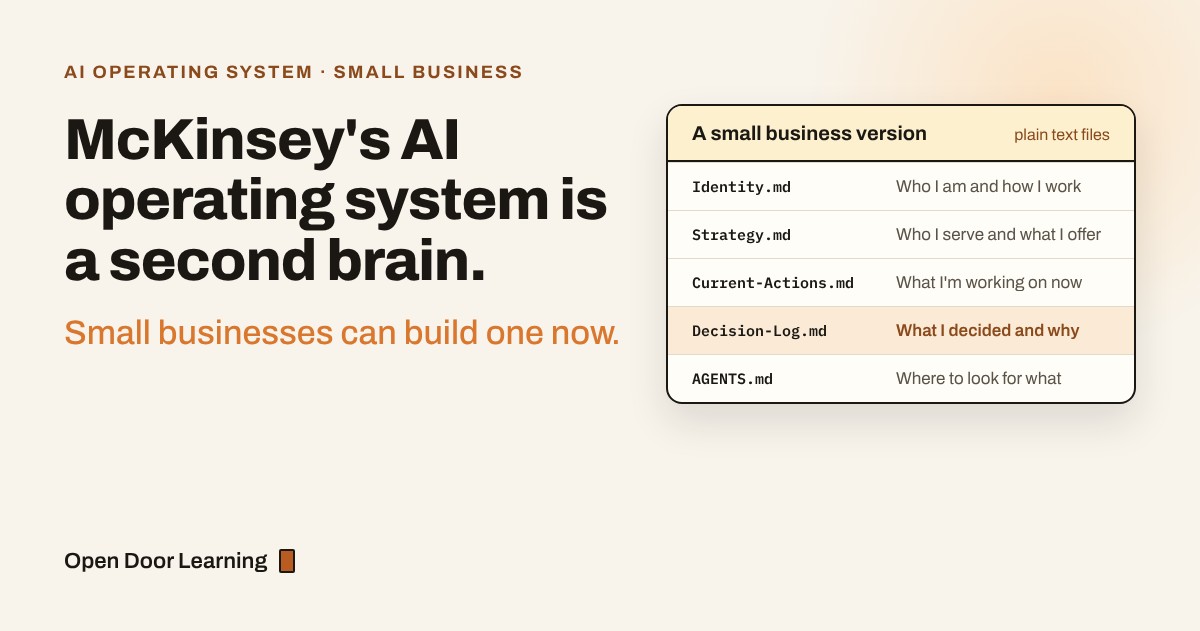
My version is a handful of plain text files in one folder:
| File | What it holds |
|---|---|
| Identity | Who I am, how I work and what I value |
| Strategy | Who I serve, what I offer and what is still undecided |
| Current actions | What I’m working on now and what’s next |
| Decision log | Each decision I’ve made, with the date and the reason |
| Instructions | A short map that tells an agent where to look for what |
Nothing in it is proprietary. Any agent that can read files can use it. When I switch tools, the files come with me.
I’ve built the same pattern for clients. One was an owner-led online education business. Years of knowledge sat across videos, support calls, member questions and email. The owner had a big project that wouldn’t start, because pulling all of that together by hand was too much. The system put the material in one place the team and their AI assistants could use.
Another was a small content team. They had already cleaned up their shared drive and their Notion workspace. What was missing was a short layer of files that told Claude what the business was trying to do, what mattered now, what had been decided and where each live record belonged. My recommendation was four files to start: identity, business, actions and decisions.
Neither business has decades of enterprise data. Both had what an AI operating system needs to get started.
The hard part is deciding what to write down
When I started, getting agents to remember the right things took real effort. Today it takes much less. Claude and ChatGPT both have built-in memory you can turn on. Even without it, today’s agents are very good at searching a folder of files and finding what matters.
So the technology is no longer what holds most owners back. What’s left is the habit McKinsey points to: recording a decision once so it gets reused.
One small example comes from my own business. In September I set a rule for events. I go to technical events only when I have a speaking role, and I go to other events only when business owners will be in the room. I wrote that down once, with the date. Now when an agent sorts upcoming events for me, it checks each one against that rule before it brings it to me. I don’t have to explain my reasoning again.
That’s a guardrail in McKinsey’s sense, at the size of one person. A big company needs a great many of them, agreed across many leaders and teams. A small business needs far fewer, and usually one person can write them.
Why this is good news for small businesses
McKinsey’s condition is hard for a big company. Fewer layers means reorganizing people. Recorded decisions, as in their example, mean getting many leaders to agree on what was decided, then keeping it current.
A small business starts much closer. The owner makes most of the decisions. There are few handoffs. Most of the knowledge lives in a few heads and a few tools.
McKinsey says the biggest untapped advantage belongs to incumbents with decades of data. For a large enterprise that may be true. For most of what an AI operating system does day to day, a small business already has enough: who it serves, how it prices, what it has decided and why. Very little of that is written down yet. That’s the gap, and an owner can start closing it this week.
That bodes well for businesses like mine, and probably for yours.
One thing to try
Start with one file. Write down five decisions you’ve already made about how your business runs, each with the date and the reason. Put the file where your AI assistant can read it, such as a Claude or ChatGPT project. Then ask it a question one of those decisions answers, and see whether it uses the decision without you explaining it again.
Sources
- Asutosh Padhi, Brian Elliott, Daniel Swan, Kim Baroudy and Vik Sohoni, “The AI operating system: A new way for CEOs to run the enterprise,” McKinsey, October 13, 2026. The 40% and 6% figures are cited in the article. The 80% and 37% figures are from McKinsey’s State of AI 2026 survey.