
This comparison comes from 20-plus hours with each personal AI agent over one week of running a solopreneur business. Spoiler alert: the business runs on Muse now.
TL;DR
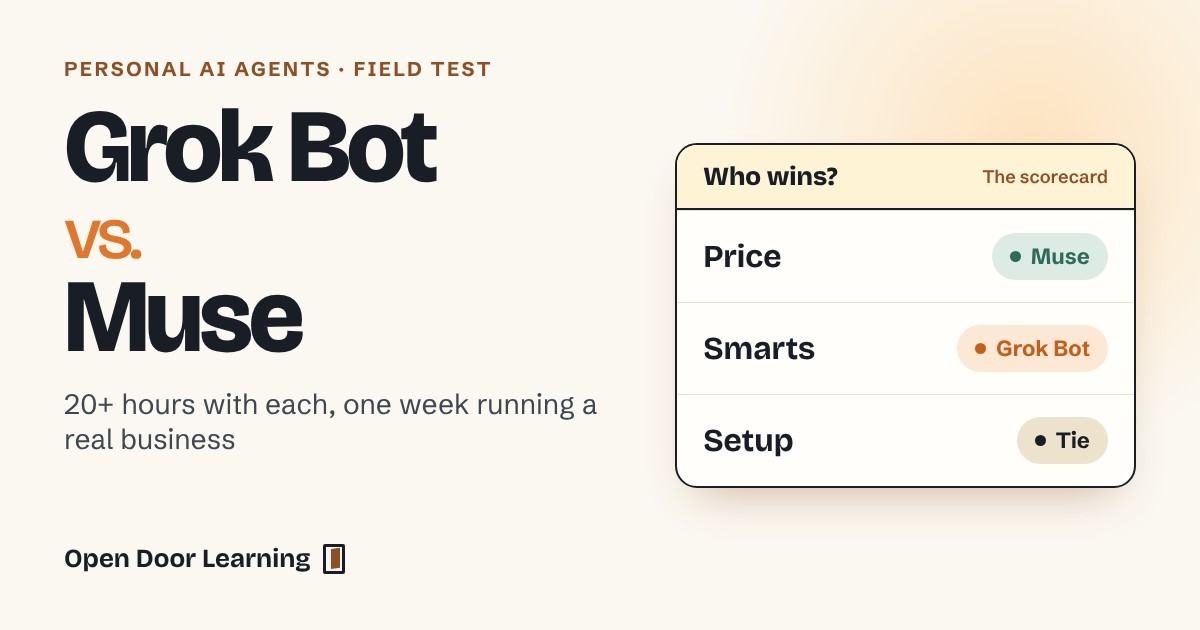
- Price: Muse wins clearly. The free plan includes 100 million tokens a week. $16 a month buys 500 million and Meta’s new Wonder model, which makes Muse a real contender on smarts as well. Grok Bot costs far more to run. This week’s usage needed the $200 plan under the old Cursor subscriptions. Usage on X’s new $30 unified plan may work out differently. It is unclear how the unified plan compares to the old Cursor plans.
- Smarts: Grok Bot wins because Grok is a better model than Muse Spark (what Muse app runs on).
- Configuration and Setup: A tie when properly set up. With instructions and jobs in files you own, both agents run the same bots and the same jobs.
Setup can be similar on both
For the way most people use a personal agent, Grok Bot bots and Muse Chats behave the same. Grok Bots = Muse Chats.
| Bot | What it does |
|---|---|
| Chief of Staff | The front door: strategy, offers and coordinating the other bots |
| Builder | Code, the website and the scheduled-job system |
| Writing and social | Daily writing, social posts and the X digest |
| Relationships | The CRM, follow-ups and morning briefings |
| Research | Sourced research requests (now a skill) |
| Personal Coach | Check-ins and a weekly review |
Each bot or chat needs the same few things to work well:
- A job description
- Shared rules for how to communicate, plus other preferences
- Its own personality, separate from the others
All of it lives in one folder / repository that both agents can read.

Some bots work better as skills
The research bot followed the same procedure every time, so it became a skill any bot can call. The relationships bot ended up calling the relationships skill for everything. I kept the relationships bot/chat because I like one place to catch up on my friends and colleagues.
Why separate bots at all?
If skills can do the work then why have multiple bots/chats at all?!
Something (or someone?) to talk to. Different conversations call for different people. A personal coach and a chief of staff cover very different ground, and a marketing lead covers different ground again. Each bot/chat plays one of those roles, so each conversation starts in the right place.
Focused context. Agents work better when their context fits the task. A separate bot/chat keeps its context apart from the others. Over time it can also keep its own personality, communication style, preferences and memory.
Control. Each bot has its own schedule, its own spending and its own permissions. The relationships bot can read email, and the writing bot cannot. When a job runs too often or costs too much, the bot that ran it is obvious, which makes each one accountable for its own work.
Price: Muse wins easily
Muse is priced in tokens, the unit these tools use to measure usage. These were its plans on October 13:
| Plan | Price | Muse tokens per week |
|---|---|---|
| Free | $0 | 100 million |
| Power | $16 a month on the web, $20 in the iPhone app | 500 million |
| Maximum | $80 a month | 3 billion |
Actual usage ran a couple hundred million tokens a week. The account also started with about 3 billion bonus tokens from invite codes. Cost was never a concern. The account moved to Power on October 13 anyway, to get the Wonder model.
Grok Bot went very differently.

| Date | Grok Bot plan | What happened |
|---|---|---|
| Oct 4 | Free | Ran out during a Sunday workshop |
| Oct 4 | $20 a month | Used up in about a day. About half went to aftercare, a job that checks email every 5 to 10 minutes and updates contact records |
| Oct 7 | $60 a month | Moved up after the $20 plan ran out |
| Oct 9 | $200 a month | Moved up again |
| Oct 12 | $30, X’s new unified plan | X bundled Grok, Grok Bot, Cursor and X Premium into one subscription. The account switched, and the $200 plan was refunded |
Why Grok Bot costs so much
Grok Bot is not expensive per message. The cost comes from three things that multiply each other.

- Frequency. Scheduled jobs run all day. Aftercare checks email every 5 to 10 minutes, and it alone used about half of the $20 plan.
- Context. Every run starts by re-reading its rules, its job file and the records it needs. On the chief of staff bot’s bigger jobs, 85 to 97% of the tokens were this re-read context.
- Length. Runs of more than 15 steps produced 52% of the week’s usage cost. Each extra step re-reads everything before it.
Recurring jobs use a lot of tokens on Muse too. Muse’s allowance is generous enough that it does not matter.
Smarts: Grok Bot wins, for now
Grok Bot is smarter. It gives better answers and handles more work on its own. With Muse’s Spark models, a lot of work went to Claude instead. That included all writing, any real planning or judgment, and anything larger than a regular chat. Grok Bot handles more of that itself, though some of it still goes to Claude.
Where exactly it wins is harder to pin down. The week was daily use, not a side-by-side test of the same tasks. The gap showed in how often work had to be handed off.
On October 7, Elon Musk announced that Grok Bot will use the best back-end model for each task, including Claude Opus 5.5. Lauren (@poteto) from the Grok Bot team confirmed the same day that Opus 5.5 was rolling out. The usage page shows one allowance for Grok’s own models and a separate one for other models.
Muse Wonder could change the math
Meta released Muse Wonder this week. Theo Browne builds AI coding tools and tests every major model. He ranks Wonder at the top alongside Claude Opus 5.5 and uses the two together for coding in his own tool, T3 Code. That is a different job from running a personal agent. He also reports two versions. “Full” is the one he likes, and it is only for subscribers. He calls the standard version “significantly worse.”
Upgrading answered part of the question. Before the upgrade, Muse said it was running on Spark. Afterward, it reported Wonder. It did not say which version. A test is under way now. Muse writes a plan and also asks Claude for one, so the two can be compared to find Wonder’s limits. If it holds up, Muse becomes the best value by a wide margin.
Your files matter more than either agent
Give it a map. Most of what a bot needs is not in the bot. It has to look things up in other files. If those files are disorganized, the agent wastes time and tokens searching.
Here is the top of the repository behind this setup:

Each folder has its own CONTEXT.md file that says what is in it and where to look next. The routing table in AGENTS.md sends each kind of work to the right folder, so an agent reads only what the task needs.
Recurring jobs work the same way. The scheduled task on Muse or Grok Bot is one sentence that names a job file, such as System/Jobs/aftercare.md, plus a few settings for that host. The procedure lives in the repository. Each run’s record is saved back there too. After a switch, the new agent sees every job and every past run.

What still doesn’t move on its own
These agents still keep some things in their own storage. Moving back to Muse turned up these gaps:
- Chat histories did not come over until each bot was asked to export its own.
- Grok Bot had not updated the file for the morning job, which scans X and prompts for a dictation.
- Connections to Facebook, Instagram and X have to be set up again on each platform.
Plan on a small migration every time you switch.
Where the heavy work goes
Personal agents are built for two things: conversations with a role, and jobs that run on a schedule. Detailed, interactive building is a different kind of work. Writing a report, designing an offer or changing code needs close back-and-forth, and that belongs in Claude or Codex rather than in a personal agent’s chat.
Both Claude and ChatGPT/Codex now coordinate several sessions on their own. Claude Projects organizes multiple sessions and keeps them in step. Codex does something similar through tasks, or through one session that manages others. Both can fan a task out to many subagents. A personal agent does not need to manage any of that.

Which one should you pick?
| If you | Pick |
|---|---|
| Are just starting out | Muse, on the free plan |
| Run a lot of scheduled jobs | Muse Power at $16 |
| Need the agent itself to be smarter and will watch usage | Grok Bot at $30 or Muse + escalate writing and other tasks to Claude/Codex |
In either case, put your rules and job descriptions in files you own first. Switching then becomes a small job.
Results from the Muse Wonder test will follow in a later article.
Sources
- Muse plans: Muse’s in-app Upgrade screen, October 13, 2026
- Grok Bot usage: the account’s usage export, priced at list API rates (estimates, October 6 to 12, 2026)
- Opus 5.5 in Grok Bot: Elon Musk on X and @poteto on X (October 7, 2026)
- Theo Browne on X: model ranking, Opus plus Wonder in T3 Code, Standard vs. Full Wonder