
I blew through more Grok Bot usage than I care to admit. Got hooked on bots and wanted to keep working with them, so I had to keep upping the ante!
- Started on the free plan Sunday and ran out the same day
- $20 plan got me 3 more days
- $60 plan got me 2 more days
- Added $20 of extra usage and that went by in 90 minutes
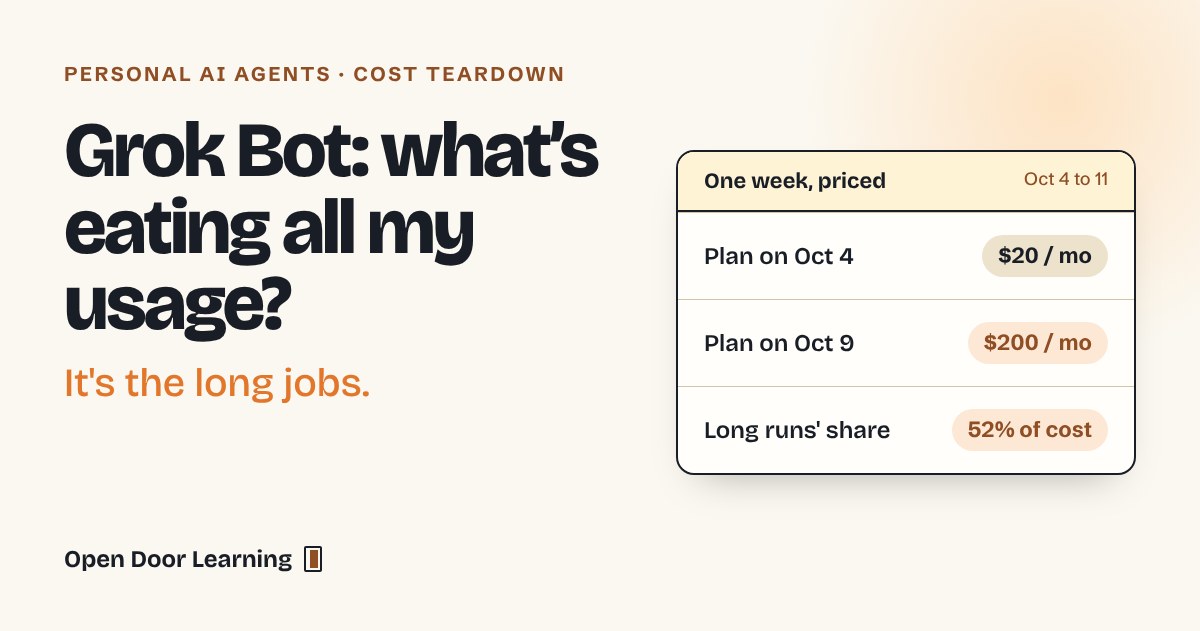
- By 9 PM Friday I was on the $200 plan, five days after starting on the free one, and I couldn’t tell you where the money went. So I spent the weekend finding out.
TL;DR
- What it cost: the plan went from $20 to $200 a month in five days.
- Why: long multi-step jobs. Runs of 16 steps or more were 52% of the cost.
- What to do: decide where a job runs before it starts, script what repeats, hand long jobs to Cursor, and talk to the bot that does the work.
Note: This analysis was done on the Cursor plan before the unified X plan came out, so some things may be a bit different now. Good chance Grok Bot is still burning usage, and because it shares quota with Cursor, it’s unclear that shifting tasks to Cursor will help.
Where the money went
The money followed long histories and long jobs.

The front door paid the most. The chief of staff bot takes every request first and hands work to the others, so it carries the longest history. From October 6 to 12, its jobs had a median cost of $0.48, from $0.02 to $15.31 across 214 jobs (observed in daily use, not a controlled test). The most expensive single job coordinated several bots and ran 222 steps.
Long jobs were half the bill. From October 4 to 11, 117 runs of 16 steps or more cost $323, which is 52% of the week. A quick question costs a few re-reads. A job like “go through these files and update the plan” costs a re-read on every step, and the re-reads grow as the job goes on.
Full reloads added $69. A cached context expires after a few idle minutes, and a fresh helper starts with nothing cached. On 248 calls a bot loaded 50,000 tokens or more with nothing cached and paid full price to load it.
Small asks add up. Five one-line spoken edits to one short email cost $1.26. About $1.10 of that was re-reading a chat of about 120,000 tokens.
Quiet jobs still cost. From October 6 to 12, runs that posted no message made up 52% of scheduled-job dollars ($27.72 of $53.64). The export does not say which bot ran them.
Why it costs so much
Grok Bot’s cost comes from three things that multiply each other.

Every step re-reads the whole book. A chat model keeps no memory between steps. Before each one it reads the whole conversation again: its instructions, its tools, its notes and everything said so far. Every tool call is a step. Every agent works this way, which is why about 90% of the tokens were re-reads. That share is normal. What makes it expensive is how long the history gets and how many steps a job takes.
The book is never empty. A brand-new bot with nothing added loaded 34,868 tokens on its first reply. The chief of staff bot was carrying 168,709, and about 80% of that was its own history, memory and job description. Starting a new chat did not reset it, because every chat on a bot shares one context.
Some providers discount re-reading far more than others. Re-reading cached context costs less than reading new text. Grok 4.7 charges a quarter of its normal input price for it. Claude Opus 5.5 charges a twentieth. When about 90% of the tokens are re-reads, that rate matters more than the headline price.
Why the bot won’t fix it for you
The bot cannot keep its own bill down, and a better prompt does not change that. It is a gap in the product, which the vendor’s staff call “not intended behavior,” with no timeline for a fix.
- No step limit. There is no tool-call cap, turn budget or max-steps setting in the docs, help pages or changelog.
- Rules are hints. Staff say chat instructions are “only a hint they can ignore.” This setup had a written rule to hand off long jobs, and the bots still ran 117 long runs in a week.
- It can’t see its own usage. No tool or API shows a bot what it has spent. As one user on the vendor’s forum put it, “the bots can’t see it at all.”
- Caps don’t stop a running job. The plans page says: “A limit is not a hard stop in the middle of a run.”
Every control that works today sits outside the bot, with the owner.
How to keep it in check
Decide where each kind of work runs before it starts. Counting steps mid-job does not work, because the bot cannot see its own count or its own cost.
- Measure before you change anything. The guess here was that scheduled jobs were the problem. They were about 8% of the cost. Most providers let you download a usage file with one row per call. Have someone technical price it at the published rates and sort the calls by how many steps each job took.
- If it repeats, make it a script. A job that runs the same way every time, like checking an inbox, can be a small script on a schedule. A script has no conversation to re-read.
- If it is long, hand it off before it starts. Decide by the kind of job, not by counting steps. “Go through these files and update the plan” is a long job. Send jobs like that to a separate agent that starts with a clean page, such as a cloud agent, Codex or Claude Code. Have the bot read the result from a file. A helper inside the same bot does not count, because its calls cost the same as the main chat’s ($0.063 against $0.061).
- Talk to the bot that does the work. Routing a request through a chief of staff bot means two long histories get re-read instead of one.
- Pass work by leaving a file. For example, the chief of staff bot writes “draft Thursday’s post” to a shared file. The writing bot reads only that file instead of the chief of staff’s whole chat.
- Ask about the re-read price when you compare tools. When most tokens are re-reads, that rate shapes the bill more than the headline price.
What happened next
On October 13 the day-to-day bots moved back to Muse, and the account upgraded to Muse’s $16 Power plan to get Meta’s new Wonder model. Power includes 500 million tokens a week. The full comparison is in Grok Bot vs. Muse: Who Wins?
The move was small because the bots’ job descriptions and scheduled jobs live in files the business owns. The multipliers moved with them, and a larger allowance only makes them cheaper.
Appendix: how it was measured
For technical readers. Every dollar figure is an estimate at list API prices, not an invoice amount.
- Data. The vendor’s usage export, one row per model call, loaded into a small SQLite pipeline.
- Prices. Grok 4.7 list rates: $2 per million tokens for input, $0.50 for cache reads, $6 for output. No separate cache-write rate is listed, so cache writes are priced like input. 33 calls on 8 other models had no published rate, so totals are floors.
- Two windows. The $616 total, long-run and full-reload figures cover October 4 to 11 (October 11 runs only to about 10:40 AM CT). The per-bot split, the chief of staff job figures and the scheduled-job split cover October 6 to 12: 9,087 calls, about $634.
- Bursts. Chat calls are grouped into one burst until they go quiet for more than 45 seconds. A long burst is 16 steps or more.
- Full reloads. A call that writes 50,000 tokens or more with nothing cached.
- Attribution. Chat bursts are matched to the bot whose chat they ran in. Scheduled runs carry no bot ID in the export, so $29 of scheduled-job cost could not be tied to any bot.
Same-job test, October 11. Three jobs, one run each, Claude Code (Opus 5.5) against a blank Grok bot. Each at its own list price.
| Job | Claude Code | Blank Grok bot |
|---|---|---|
| One-line answer | 213,005 tokens, $0.48 | 74,936 tokens, $0.10 |
| Write one 150-word file | 128,069 tokens, $0.21 | 126,413 tokens, $0.08 |
| Read twelve reports, write a summary | 560,335 tokens, $1.49 | 400,709 tokens, $0.27 |
The blank bot cost less than half of what Claude Code did on every job, and about a fifth on two of them. About half of Claude’s higher cost on the third job was price and half was that it read more. Claude’s summary caught one detail the bot missed. The models differ as well as the platform, so read this as a sanity check that the platform itself is not the problem, not as a benchmark.
Sources
- Grok Bot usage: the account’s usage export, October 4 to 12, 2026, priced at list API rates (estimates)
- Plan history: the account’s billing history, October 4 to 12, 2026
- Same-job test: run October 11, 2026, from each runner’s own usage figures
- “The full transcript gets sent to the model on every turn” and “not intended behavior”: vendor staff, forum thread 168333 (August to September 2026)
- “Only a hint they can ignore”: vendor staff, forum thread 170271 (September 2, 2026)
- “The bots can’t see it at all”: user, forum thread 169926 (October 7, 2026)
- “A limit is not a hard stop in the middle of a run”: Grok Bot plans help page
- “Context compounds”: Grok Bot docs
- Cache-read prices: xAI Grok 4.7 model page and Anthropic pricing
- Muse plans: Muse’s in-app Upgrade screen, October 13, 2026